Through the Culture Monitor dashboard, the Boekman Foundation provides a wealth of sources and data. A goldmine of information with which you can create your own charts. Want to work data-driven? Dive into the data of the Culture Monitor!
Digital Transformation
The Digital Transformation theme page is part of the Culture Monitor for the first time this year. The current focus on the topic - from policymakers, the sector, and the public - and the significant opportunities and challenges it presents for the cultural sector make digital transformation an important theme to monitor.
Digital transformation progresses differently across the various domains of the Culture Monitor, which is why it is highlighted separately per domain on the theme page. There are still significant differences between primarily virtual domains such as gaming and music streaming and traditionally physical domains such as museums and heritage.
Nevertheless, digital transformation also offers opportunities for cultural organizations. For example, for creation, reaching new audiences, staying connected with future audiences, and ensuring that culture from the past remains available.
Shared Definition
DEN and Boekman use the same definition of digital transformation. This contributes to consistency within the sector. The key features of this definition are the value for the audience and the fact that digital transformation affects all facets of an organization. It goes beyond digitization, which involves converting information into a digital form.
The Digital Transformation Definition
Digital transformation is a continuous change of the entire organization, driven and supported by the increasing use of digital technologies. The core of digital transformation is a change in the business model. The main question is how the organization can continue to deliver value to its customers. The transformation affects all facets of an organization, including culture, strategy, processes, relationships, and employee skills.
Source: S. Jansen, The Management Book for Digital Transformation, 2022
Want to learn more about digital transformation and what you can achieve with it in your organization? Read this article.
Data in the Culture Monitor, a Starting Point for Data-Driven Work
The Culture Monitor also contains statistical data about the cultural sector. With this, you can create your own charts based on your desired indicators. This allows you to make data-driven decisions within your organization.
What You Can Do with It
The Culture Monitor provides insights into, for example, the number of organizations within the cultural sector. It also shows to what extent the cultural sector reaches society; for this, you can look at the percentage of general culture visitors in the Netherlands. By comparing the figures of different years or types of institutions, you gain insights into trends and developments in the sector and can tailor your offerings accordingly.
What Do We See?
In 2021, the sector consisted of 906 libraries, 334 organizations with venues for performing arts, 629 museums, and 52 video-on-demand platforms.

From 2018 to 2020, the share of culture visitors in the Netherlands decreased from 94% to 84%. By selecting indicators such as the share of museum visitors and the number of cinema visitors, you can also examine culture visitors in more detail.

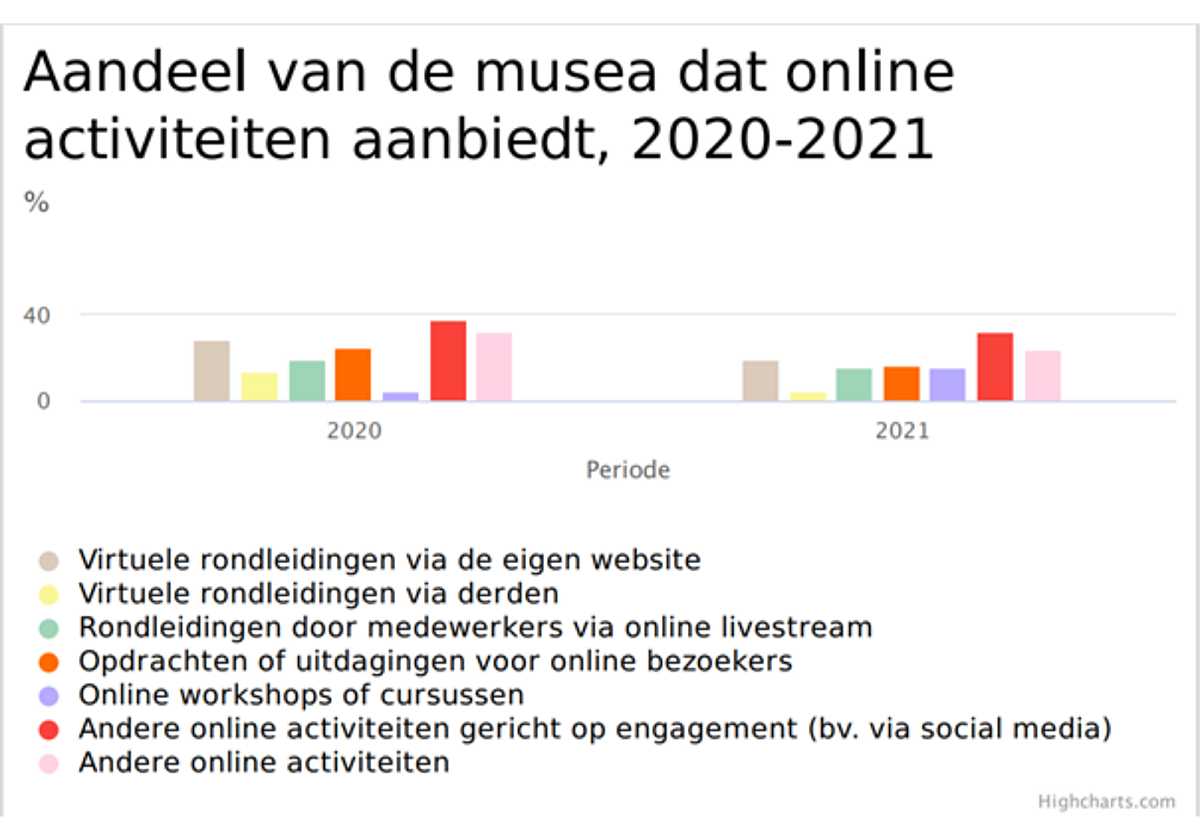
In 2021, three-quarters of museums offered online activities. The chart below shows the distribution of different online activities in 2020 and 2021. Additionally, experiments with adding digital applications or immersive experiences to exhibitions have significantly increased in recent years. For example, the use of VR or AR in museum setups, livestreams, performances, or a so-called Museum of the Future: a study by, among others, Beeld en Geluid on the role of Virtual Reality (VR) in creating shared experiences around digitized museum objects.
Design is the fastest-growing market within the creative industry. The rise of digital design – where design competencies are combined with digital skills such as software development and the application of artificial intelligence (AI) – has put design on the map more than ever.
Investigated performing arts companies attracted roughly the same number of visitors with online performances in 2020 and 2021 as in previous years.
Digital Transformation Made Transparent
The currently available sources are not yet sufficient to use data to make the state of digital transformation in the cultural sector clear. Standardized and more up-to-date data increasingly make it possible for the sector to work data-driven. To compare different types of institutions effectively, it is important to collect data on the same points, in the same period, and in the same units.
Data is the instrument of the future. The Audience Data Taskforce is committed to the (safe) use of audience data in the cultural sector. Read more about this collaboration.
Why Data in the Cultural Sector?
Insight into Potential Audience
Digital applications and data make it possible to gain more insight into the existing and potential audience. If this data becomes available and usable for the sector, institutions can better respond to their various target groups.
Trends and Developments
Trends and developments visible in data make cultural institutions resilient and adaptable to these changes. Institutions can compare their own data with data from the sector to position themselves within the whole and discover opportunities.
Data-Driven Work
Data-driven work is part of a successful digital transformation. You can see the effect of the steps you take and use insights from the data to make further decisions.
Ambitions for the Future
Based on the currently available data on the use of digital technologies in production, distribution, consumption, and archiving, you cannot yet get a clear picture of the extent to which institutions fundamentally change due to digital transformation. How does it influence organizational culture, strategy, processes, relationships, and employee skills? What is the impact of digital transformation? DEN supports the Boekman Foundation in its ambitions to investigate how this essential knowledge can be strengthened as the theme develops further.
Another shared ambition of Boekman and DEN lies at the intersection of ecological sustainability and digital transformation: to what extent is the cultural sector consciously working on the footprint of digital services? And how does the CO2 impact of digital compare to that of physical? The Culture Monitor already includes a theme page on sustainability in the cultural sector, and DEN also has a page with tips on how to approach digital projects sustainably.

More news by topic