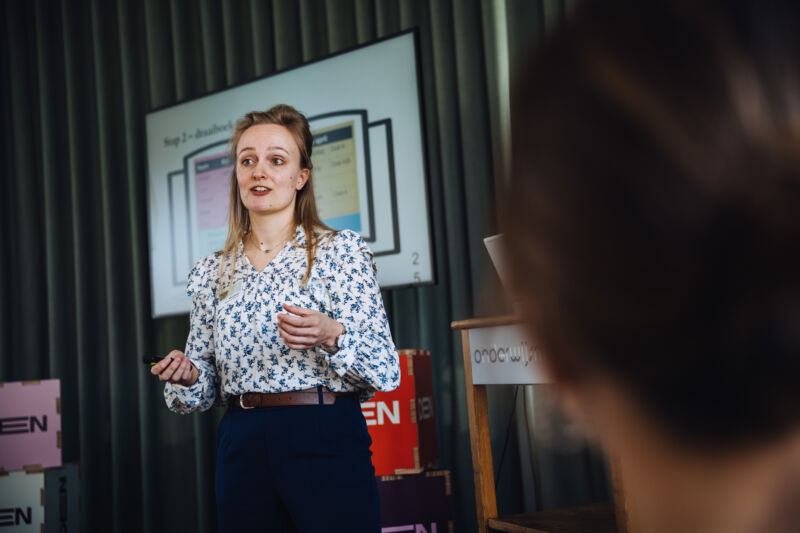
Meer horen over Lander23? Bekijk of luister naar DEN's podcast Cultuurshift seizoen 3, aflevering 4: Waarom gaming en cultuur samen kunnen gaan.
Spaceship Lander23
Imagine standing in a dark alien environment. And in your ear, your team captain whispers which direction to go.
As a visitor, and therefore also as a participant, you are part of the crew of Lander23, a spaceship that lands on an unknown planet. One group stays in the spaceship, and another group puts on tactical vests and goes 'outside' to explore. They communicate with each other through their voices and screens. Everything revolves around the mission that the team members complete together. It's a format we don't often see in the sector.
“I always describe it as part LARP, or Live Action Role Play, and part a simulation of a post-apocalyptic call center.” Tom Keane is co-founder and creative lead at Meaning Machine, a company specializing in games and interactive AI characters. He collaborated with Punchdrunk and knows how to create real-time conversations in an exciting game. “It's a special hybrid form; in fact, we've created a game that takes place in a theater space.”
This form is different from what you're used to from Punchdrunk. While their theater experiences are innovative, you are still always a spectator. In Lander23, you actively participate, but in a story with the atmosphere of Alien or Terminator: you have a mission, and the story is built around that—call it an interactive quest.
A personal agenda
Keane sees a revolution coming, where these kinds of 'gamified' conversations seep into the real world thanks to AI. "In game design, it's initially about what the player wants to do. But that's not enough; players must truly feel that their choices have meaning.”
And to achieve that, says Tom, you need to create characters that come to life, characters with their own personalities and, most importantly: their own agenda."
This 'questification' (turning your content into a mission) works excellently within heritage, as Keane demonstrates with an example involving the Egyptian Gallery in the Bristol museum.
The gods on WhatsApp
A traditional exhibition that had remained unchanged for ten years received a temporary digital layer. Visitors scan a QR code and suddenly find themselves in contact with the Egyptian gods via a kind of WhatsApp. The gods specifically ask for help: "I need to guide this woman to the afterlife, but I’m looking for specific jars. Can you look around the room to see if you spot them?"
You then search the gallery for the right objects. If you ask if that’s what the god is looking for, the god responds: 'Yes, I need that, but I’m also looking for something to store, for example, the liver.'

Engaged participants
The result was astonishing. Visitors who would normally walk through the room in a few minutes now stayed to study objects intensively. After all, they had to relay the details precisely to the gods.
The exhibition itself remained the same, but the interactive context transformed passive passersby into deeply engaged participants. Suddenly, an incredibly interesting digital layer emerges that 'gamifies' the museum experience.
Emotionally charged goal
From his expertise, Tom advises and contributes to groundbreaking hybrid experiences within the cultural and museum sector, including Lander23. If you want to get started with an interactive quest yourself, here’s his most important advice:
“A quest only truly works if the characters you communicate with have their own emotionally charged goals. Only when choices feel meaningful to the player does real engagement arise."
Are you curious about the episode of ‘Cultuurshift’ where Anic van Damme, Splinter Chabot, and interactive game experience expert Hayo Wagenaar from his company IJsfontein discuss this approach? In this video, you can watch the entire podcast episode.

Podcast Cultuurshift Season 3
In the third season of the podcast ‘Cultuurshift’, we speak with a different international pioneer in the field of culture and technology in each episode. Think innovations around gamification, AI, and data-driven operations. How do they approach it, and what is the significant added value for their audience and organization?
Host Anic van Damme and sidekick Splinter Chabot discuss this case with an expert from the sector and ask the question: what inspiration can we in the Netherlands draw from this innovative example?
Episode 4 is about interactive quests, how you can activate your visitor with a mission, and make more impact.
More articles per topic