Room for experimentation
The goal of the designers-in-residence program is to introduce innovative digital storytelling techniques to the museum. This enriches the visitor experience and inspires the museum team to make greater use of the latest immersive storytelling methods, such as AI and AR.
Innovative digital storytelling is often appealing to new and younger audiences. Moreover, it can extend the visitor experience. With this, Design Museum Den Bosch is strategically working on audience building and diversification.
Through three different test cases, the museum gains insight into which forms of XR (extended reality) resonate with the museum audience, which stories from exhibitions and the collection are suited for digital presentation techniques, and how curators can incorporate XR into their projects.
Additionally, the designers-in-residence will design a decision-making tool that allows museum staff to determine which digital storytelling methods best fit different goals.
Test cases
The first test case consisted of a series of small experiments with interactivity, including the presentation PostPlanet. Here, a VR viewer invites visitors to look at the interaction between humans and the planet in a new way. There was also the project Posse, where visitors' postures were mirrored by figures on a wall of screens.

The second test case involves an interactive laser installation as part of an exhibition. Here, a grid of red laser beams on the ceiling reacts to the movements of visitors. The installation adds an extra layer of meaning, thereby enhancing the artistic value of the audience experience.
Tracking visitors' movements in the exhibition also provides information about how visitors navigate the space. Where do they linger, and where do they pass by quickly? This data provides insights into which parts are popular among visitors and what could be improved or changed in future setups. The audience data is anonymized and stored on a local server to ensure privacy.
For the third test case, the designers-in-residence take a step outside the museum walls. How can visitors be engaged through XR even outside the museum? What is needed to extend the museum visit into the city?

Experiences
Design Museum Den Bosch is learning a lot from this project. The team of curators is being challenged to view an exhibition more as an immersive experience, stimulating multiple senses of the visitors. Insights have been gained into how technology can enrich an exhibition and add value to the audience experience.
Conversely, the designers-in-residence are learning a lot from working in a museum setting.
For instance, they had to design the hardware interfaces in a very user-friendly way: think of a device with only four buttons and corresponding options. This makes the technology easy to use for both visitors and museum attendants.
The decision-making tool that will mark the end of the project will bring together all the knowledge and experiences from the past period, ensuring that the digital layer becomes an essential part of the narrative in future exhibitions. What the test cases have mainly shown is that digital transformation is not so much about a specific technical application, but about how it can be made content-relevant and practically feasible for everyone within the museum.
Innovation hub
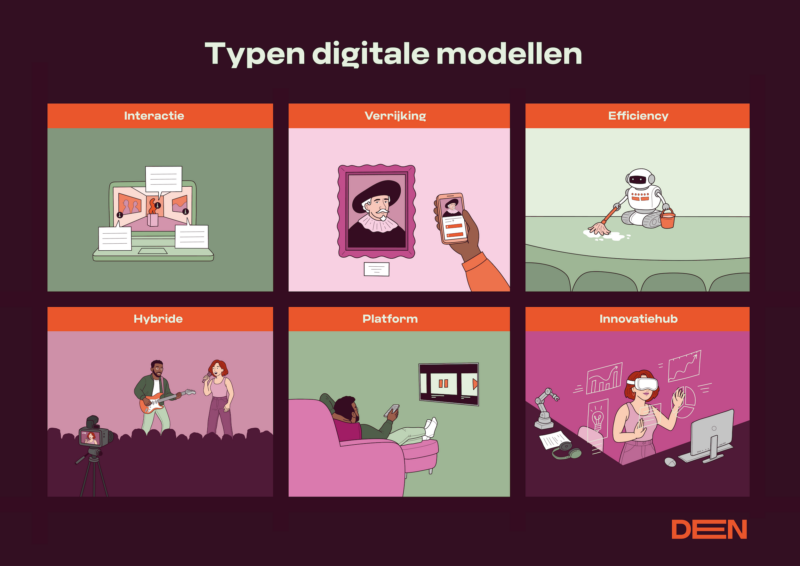
The designers-in-residence project of Design Museum Den Bosch is a great example of an innovation hub. It provides space for experimentation to make the organization future-proof.
From experiment to strategic business model
The 'designers-in-residence' project of Design Museum Den Bosch demonstrates how you can test the potential of new technologies through an innovation hub (or experimental phase) before choosing a definitive digital business model. This experiment to enrich the experience is crucial, but it is only one step. Want to know how to turn your successful experiment into a sustainable, future-proof strategy? There are various digital business models (such as the Hybrid, Platform, or Efficiency model) that you can use to scale your organization. Interested? View all models and strategies here (opens in new tab).
Want to work with digital business models yourself?
The Digital Business Model Canvas is the proven method to move away from project-based thinking and structurally translate your digital opportunities into measurable, sustainable value (such as stronger audience relationships and new revenue models). Download the fillable canvas and receive our best tips directly in your inbox. Start today with embedding your digital strategy.

More articles per topic